

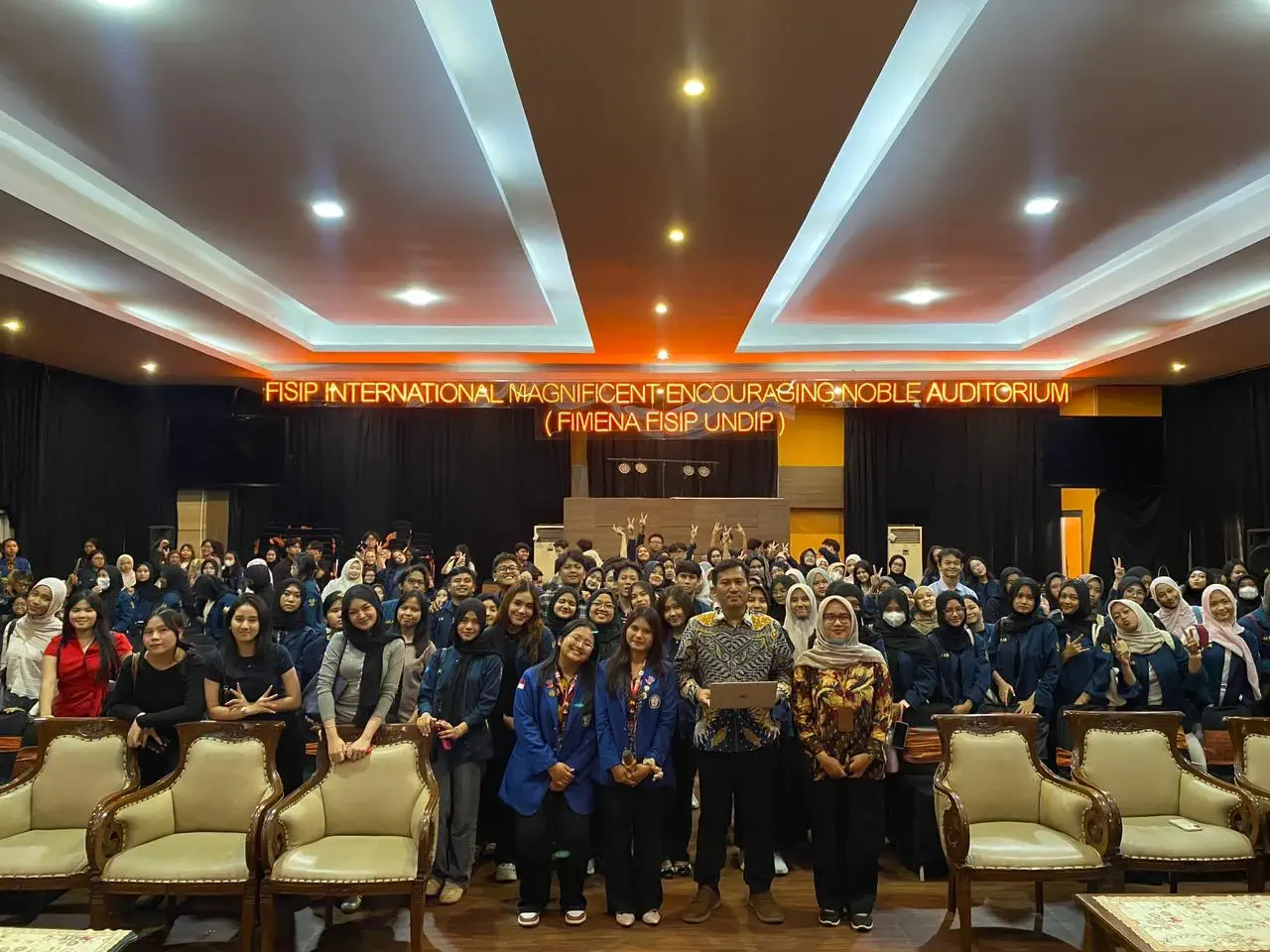
Understanding the political and economic conditions in Indonesia is crucial for students as the younger generation and future leaders of the nation. Global economic dynamics, government policy changes, technological advancements, and international geopolitical conditions significantly influence Indonesia’s economic growth. Therefore, students are not only required to understand theories in lectures but also need to be aware of the ongoing social, political, and economic conditions in society. As an effort to enhance students’ knowledge and awareness of these issues, the HMPS Business Administration organized the EKOPOLIS event with the theme “The Role of Students in Promoting Politics that Impact Economic Development.”
The EKOPOLIS activity was held on May 20, 2026, at the Faculty of Social and Political Sciences, Diponegoro University. This event featured Bangkit A. Wiryawan, S.Sos., M.A., Ph.D., as the speaker and Dhaifina Idznitia Apriyani Naimi, S.M., M.B.A., as the moderator. This discussion forum was attended by Business Administration students and students from various cohorts interested in national political and economic issues. The main objective of this activity was to provide students with an understanding of Indonesia’s current economic conditions and to encourage them to be more active in overseeing public policy and national development.
The activity began with participant registration and an opening by the MC, followed by speeches from the Head of the Business Administration Study Program, the Chairperson of HMPS Business Administration 2026 (represented by the Vice Chairperson), and the Chairperson of the EKOPOLIS organizing committee. After the opening, the moderator introduced the speaker and opened the discussion session. In his presentation, Bangkit A. Wiryawan explained that the relationship between politics and economics is inseparable, as both influence the national development process. The speaker also explained the history of economic development, which originally emerged from discussions of politics and the government’s role in regulating society.
During the material session, the speaker discussed Indonesia’s economic journey from the 1998 reform era to the present day. According to the speaker, Indonesia faced various economic challenges due to weak economic governance in the past. However, the Indonesian economy gradually improved during the post-reform government period, although it still faces various criticisms and development challenges. The speaker also touched on the COVID-19 pandemic, which caused economic contractions in various countries, including Indonesia. Nevertheless, Indonesia is considered capable of recovering and remains one of the largest economic powers in the ASEAN region due to its large population and strong domestic consumption.
In addition to discussing economic growth, the speaker explained that Indonesia is still classified as a lower-middle-income country, with economic growth of around five percent per year. Indonesia’s per capita income is estimated at around US$4,000, but this figure is considered insufficient to make Indonesia a developed country. In his presentation, the speaker explained that investment is a crucial factor in national economic development. Currently, investment in the mining sector is growing quite rapidly, especially in the Sulawesi region. However, this sector is considered unable to create as many jobs as the manufacturing sector.
Indonesia’s current economic conditions are also influenced by global factors such as world inflation, the weakening of the rupiah exchange rate, and investment competition with other countries such as Vietnam and Malaysia. The speaker explained that Indonesia still faces obstacles in developing high-tech industries due to regulations considered quite complex. Additionally, Indonesia’s unemployment rate, at around five percent, is still considered relatively high compared to several other countries in the Southeast Asian region. Therefore, the government needs to strengthen the industrial sector, investment, and human resource development so that economic growth can run more optimally.
During the discussion, the speaker also emphasized the importance of the student’s role as agents of social and political change. Students are considered to have an important position in overseeing government policies and voicing the interests of the public. The 1998 student movement is a concrete example of how students were able to drive significant changes in Indonesia’s governmental system. According to the speaker, student organizations such as the Student Executive Board (BEM) and the student senate remain relevant today because students continue to be a critical group regarding various social issues and public policies.
The discussion session was interactive, with participants actively asking questions and providing responses related to the material presented. One participant asked whether the idealism of today’s younger generation is diminishing due to environmental influences and certain interests. The speaker explained that the younger generation still has high idealism because they are not yet heavily influenced by personal interests. However, environmental conditions and social pressures often cause individuals to change gradually when entering the workforce or government. Another participant also asked about the high rate of corruption in Indonesia and its connection to the values of Pancasila. The speaker explained that each generation faces different challenges according to the social and economic conditions of their time.
Through the EKOPOLIS activity, participants not only gained insights into Indonesia’s political and economic conditions but also had an academic discussion space that encourages critical and analytical thinking skills. This forum serves as a platform for students to exchange views and increase awareness of the importance of youth involvement in national development. This activity also demonstrates that students have a vital role in maintaining democracy, overseeing public policies, and contributing positively to Indonesia’s future economic development. The participants’ enthusiasm during the event showed that students have a high concern for the developing social, political, and economic issues in Indonesia. Therefore, activities like EKOPOLIS are expected to continue being held as a means of education and student knowledge development so they can become a critical, adaptive generation that actively contributes to national development.